If you are weighing open cell vs closed cell spray foam for your home, you are already asking the right question. Both are excellent insulators that seal air leaks far better than old-school fiberglass batts — but they behave very differently, cost different amounts, and each shines in different parts of a house. This plain-English guide walks you through what sets them apart, where each one belongs, and how to choose the right foam for a New York climate.
What Is Spray Foam Insulation?
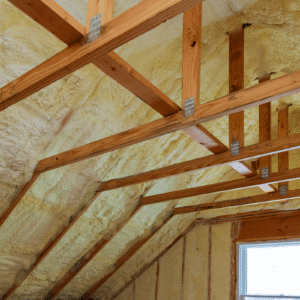
Spray foam is a two-part liquid that is mixed on site and sprayed into place, where it expands and hardens into a solid layer of insulation. As it expands, it fills cracks, gaps, and hard-to-reach cavities, creating both a thermal barrier and an air seal. That air-sealing quality is a big reason spray foam can cut heating and cooling energy use by roughly 30–50% compared with a leaky, under-insulated home. A tightly sealed home may also stay cleaner — airtight homes can have up to 50% less dust drifting in from outside.
There are two main types: open cell and closed cell. The names refer to the structure of the tiny bubbles (cells) inside the cured foam.
Open Cell Spray Foam (“Half Pound” Foam)
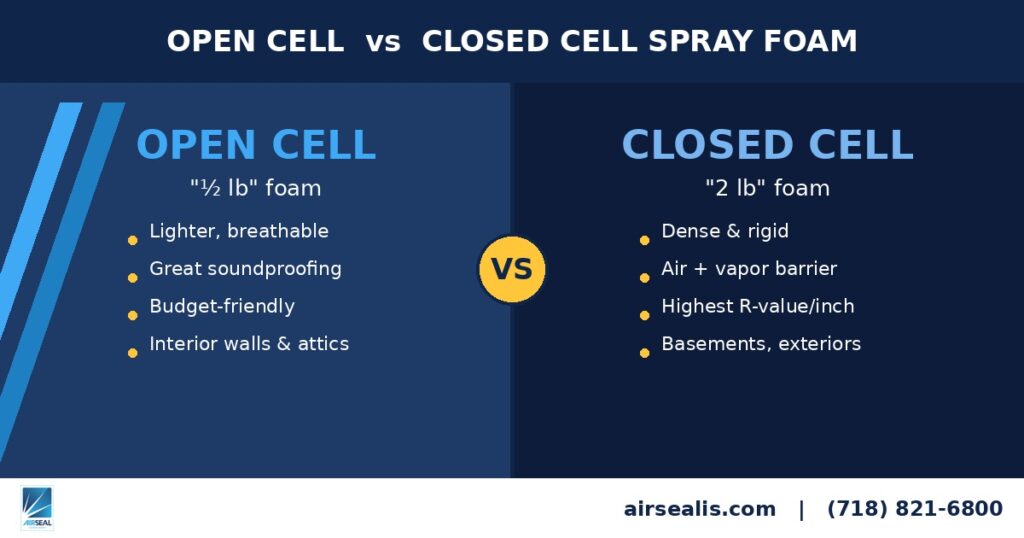
Open cell foam — often called half pound foam because of its density (about ½ lb per cubic foot) — has cells that are not fully closed, so air can move through it. That structure makes it soft, light, and breathable.
- R-value: about R-3.6 per inch of spray foam.
- Breathable: allows some vapor movement, which can help certain wall assemblies dry out.
- Best sound deadening: its open structure absorbs sound well, making it a favorite for interior walls and media rooms.
- Big expansion: it expands aggressively to fill hard-to-reach cavities and irregular framing.
- Budget-friendly: generally more affordable per square foot than closed cell.
- Where it goes: inside conditioned space only — great for interior walls and attic rooflines.
Closed Cell Spray Foam (“2 Pound” Foam)
Closed cell foam — known as 2 pound foam for its higher density (about 2 lb per cubic foot) — has fully closed, tightly packed cells. That makes it dense, rigid, and far more resistant to moisture.
- R-value: about R-5.6 to R-7 per inch — the highest spray foam R-value available, so you get more insulation in less thickness.
- Adds strength: its rigid structure can add structural stiffness to walls and roof decks.
- All-in-one: acts as an air barrier, a vapor barrier, and insulation at the same time.
- Moisture-resistant: stands up to damp conditions, so it does not readily absorb water.
- Where it goes: crawl spaces, rim joists, exterior walls, cold or damp areas, and commercial or industrial jobs.
Open Cell vs Closed Cell Spray Foam: Side-by-Side Comparison
| Feature | Open Cell (½ lb) | Closed Cell (2 lb) |
|---|---|---|
| R-value per inch | ~R-3.6 | ~R-5.6–R-7 |
| Density | Light, soft | Dense, rigid |
| Air barrier | Yes | Yes |
| Vapor barrier | No (breathable) | Yes |
| Moisture resistance | Lower | High |
| Adds structural strength | No | Yes |
| Sound deadening | Excellent | Good |
| Relative cost | More budget-friendly | Higher |
| Best for | Interior walls, attic rooflines | Crawl spaces, rim joists, exterior walls, damp/cold areas |
How Much Do You Need? Thickness by Zone
The right thickness depends on the type of foam and the part of the house. Here is general guidance our crews use as a starting point — a proper assessment confirms the exact spec for your home.
Closed Cell (2 lb)
- Rooflines: 2.5–4″ (about R-19–R-25)
- Walls: 2–3″ (about R-13–R-19)
- Floors: 2.5–4″ (about R-19–R-25)
Open Cell (½ lb)
- Rooflines: 5.5–8″ (about R-19–R-30)
- Walls: 3.5–5.5″ (about R-13–R-19)
- Floors: 5.5–8″ (about R-19–R-30)
Because closed cell packs more spray foam R-value into each inch, it reaches the same R-value in roughly half the thickness — handy where framing depth is tight. Want the science behind these numbers? See our deeper look at spray foam R-value and building science.
Which Spray Foam Is Best? How to Choose
There is no single winner in the open cell vs closed cell spray foam debate — the best choice depends on the job. Here is how to think it through:
- Budget: if cost is the main driver and the area stays dry and conditioned, open cell often delivers strong value.
- Moisture exposure: for crawl spaces, basements, rim joists, or anywhere dampness is a concern, closed cell’s moisture resistance and built-in vapor barrier make it the safer pick.
- Space constraints: shallow framing or tight cavities favor closed cell, which hits target R-values in less thickness.
- Soundproofing: for quiet bedrooms, home offices, or media rooms, open cell’s sound-absorbing structure is hard to beat.
The New York Angle: Cold Winters, Humid Summers, Older Homes
New York homes face a demanding climate — freezing winters, humid summers, and plenty of older housing stock with drafty framing and uneven cavities. In many NYC row houses and older homes, air leakage is the real problem, and either foam will tighten things up dramatically.
Closed cell often makes the most sense in New York where moisture and cold surfaces meet: crawl spaces, basements, rim joists, and exterior walls that take the brunt of winter. For attic rooflines and interior walls inside the conditioned envelope, open cell can be a cost-effective way to seal and insulate a large area. When it comes to attic insulation in New York, many homeowners land on a mix — closed cell where moisture and strength matter, open cell where budget and sound control lead. Curious whether foam is a safe fit for your family? Read is spray foam insulation safe.
Frequently Asked Questions
Is open cell or closed cell spray foam better?
Neither is universally better — it depends on the location and goal. Closed cell offers a higher R-value, moisture resistance, and added strength, so it wins in crawl spaces, rim joists, and damp or cold areas. Open cell is more budget-friendly and excellent for soundproofing interior walls and attic rooflines inside conditioned space.
What is the R-value of open cell vs closed cell spray foam?
Open cell (half pound foam) is about R-3.6 per inch, while closed cell (2 pound foam) is about R-5.6 to R-7 per inch. That means closed cell reaches the same spray foam R-value in roughly half the thickness of open cell.
Why is closed cell spray foam more expensive?
Closed cell is denser and uses more material per square foot, and it does three jobs at once — air barrier, vapor barrier, and insulation. Its higher R-value per inch and moisture resistance also make it the go-to for demanding spots, which is why it typically costs more than open cell.
Not Sure Which Foam Your Home Needs?
Let AirSeal Insulation Systems take a look. We serve New York City and New York State, and our team will recommend the right foam for each zone of your home — no guesswork, no pressure.
Or call (718) 821-6800.